
Seminar Summary, 26/11/2025
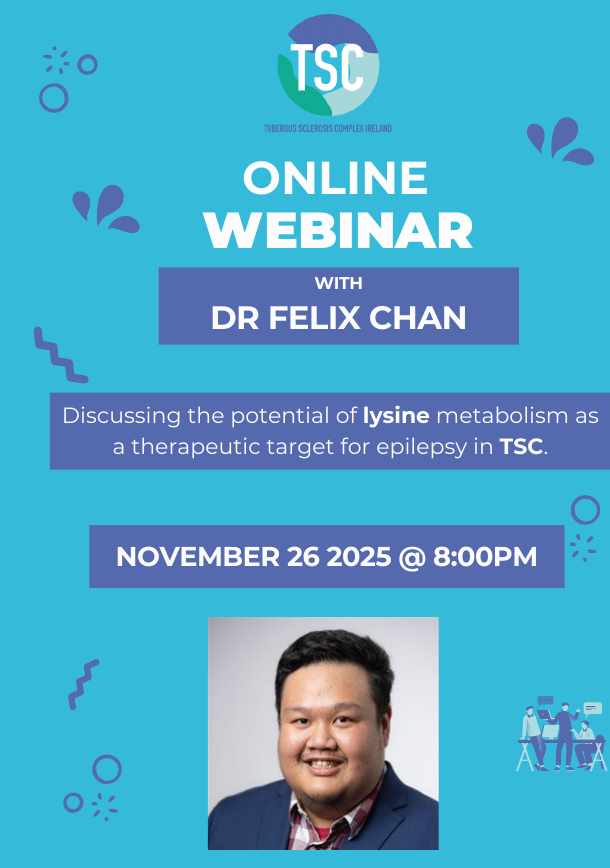
Dr Felix Chan, who held the seminar for TSC Ireland, is an Assistant Professor in Pharmacology at the School of Health Sciences at University of Birmingham.
He opened his talk by explaining why he studies neuroscience: His interest in neuroscience stemmed from the importance of the brain, especially from a metabolic perspective. The brain makes up only 2% of body mass but consumes 20% of energy, that is equivalent to a salmon and rice dinner per day.
He went on to explain that epilepsy interest him as a metabolic conundrum. Epilepsy is defined by excessive electrical energy. Both low and high levels of energy supply to the brain can cause epilepsy. So, either the lack of energy supply to the brain or too much energy can cause seizures. This means that a good metabolism and a good energy supply is needed.
His current work focussed on the amino acid lysine. Amino acids are the chemicals that make up proteins in our food and our body. The amino acid lysine is one of the animo acids that cannot be created by the body itself. The only source of lysine for the body is food, and lysine needs to be taken up with the food. In food lysine is present in proteins. In the body, lysine is broken down by an enzyme. The chemical breaks down into is 2-aminoadipate which was called 2-AA for the rest of the talk.
Dr. Chan told us that he became first interested in TSC while working at Brown University in the USA. He discovered a connection between lysine levels and TSC (and other genetic epilepsies). Studying tubers that had to be surgically removed in TSC patient after they were removed, he found out that in the brain material from those patients there was more 2-AA but less lysine present. That means that more lysine is broken down by the enzyme. This was also This was also true for some other genetic epilepsies.
He then showed some work he did in the lab on lysine: First, he used cell cultures of nerve cells. Cell cultures are cells that are grown in medium on small dishes. He recorded the electrical activity of the nerve cells and found out that adding 2-AA made the nerve cells more active. They fired more electrical impulses at higher frequency and without the synchronisation they usually show. Second, he studied brain slices of mice. For brain slices, a slice of a mouse brain is kept functioning for a few hours in a physiological solution. In collaboration with Mark Cunningham at TCD he again recorded the electrical activity and found that the addition of 2-AA caused seizure like activity in the brain slice.
Together this is evidence that manipulation the breakdown of lysine in the brain might reduce seizure activity. He the showed us three ways how he is trying to manipulate this pathway:
(1) Reduced/no intake of lysine with food: This is a lysine restricted diet that has been used in different genetic epilepsies. The diet consists of special low protein products, for example rice with removed protein, and protein milks/sachets where lysine has been removed. This protein tastes fishy but there are flavours available. The diet is very restrictive, needs specialised products and needs to be followed under medical surveillance. Is has not been tested for TSC. Dr. Chan has a group of persons with these another genetic epilepsy (I didn’t note which one) who are using this diet.
(2) Block the enzyme that breaks down lysine into 2-AA: Dr. Chan is looking for a new drug that would block this enzyme. This is in the early stage of development, and he would plan to study its effects in pyridoxine dependent epilepsy first. That means this drug is 5-10 years away from clinical use.
(3) Gene editing to reduce the enzyme breaking down: Here, he is working on a gene therapy that is based on the Covid mRNA vaccine that would change the genes that affect this lysine breaking enzyme with the goal to reduce lysine breakdown and thus 2-AA levels.
He asked us four questions:
1. How likely are you to try therapy based on the restricted diet?
2. How likely are you to try therapy based on the new drug?
3. How likely are you to try therapy based on the gene therapy?
4. Which one should I focus on as a researcher for development?
He finished by highlighting a sleep in epilepsy study he is recruiting for and acknowledging his team and collaborators.